|
Info Sheets
|
|
| | | | | | | | | | | | | | | | | | | |
|
Out- side
|
| |
|
|
|
|
|
|
|
ADVERTISEMENT |
 |
|
ADVERTISEMENT |
|
ADVERTISEMENT |
 |
|
ADVERTISEMENT |
|
ADVERTISEMENT |
 |
|
ADVERTISEMENT |
|
| | | | |
Result : Searchterm 'T2*' found in 2 terms [ ] and 40 definitions [ ]
| 1 - 5 (of 42) nextResult Pages : [1] [2 3 4 5 6 7 8 9] | |  | |
 |
Searchterm 'T2*'
was also found in the following service of MR-TIP.com: |
|
| | | |  |  |
| T2* |  |
| |
|
| | |
Further Reading: |
Basics:
|
| | |
|  |
 |
MRI Resources |
|
| | | |  |  | |  |
 |
Searchterm 'T2*'
was also found in the following service of MR-TIP.com: |
|
| | | |
|
 |  |
| Gradient Echo Sequence |   |
| |
|
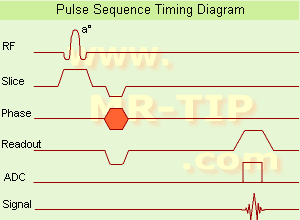
(GRE - sequence) A gradient echo is generated by using a pair of bipolar gradient pulses. In the pulse sequence timing diagram, the basic gradient echo sequence is illustrated. There is no refocusing 180° pulse and the data are sampled during a gradient echo, which is achieved by dephasing the spins with a negatively pulsed gradient before they are rephased by an opposite gradient with opposite polarity to generate the echo.
See also the Pulse Sequence Timing Diagram. There you will find a description of the components.
The excitation pulse is termed the alpha pulse a. It tilts the magnetization by a flip angle a, which is typically between 0° and 90°. With a small flip angle there is a reduction in the value of transverse magnetization that will affect subsequent RF pulses.
The flip angle can also be slowly increased during data acquisition (variable flip angle: tilt optimized nonsaturation excitation).
The data are not acquired in a steady state, where z-magnetization recovery and destruction by ad-pulses are balanced.
However, the z-magnetization is used up by tilting a little more of the remaining z-magnetization into the xy-plane for each acquired imaging line.
Gradient echo imaging is typically accomplished by examining the FID, whereas the read gradient is turned on for localization of the signal in the readout direction. T2* is the characteristic decay time constant associated with the FID. The contrast and signal generated by a gradient echo depend on the size of the longitudinal magnetization and the flip angle.
When a = 90° the sequence is identical to the so-called partial saturation or saturation recovery pulse sequence.
In standard GRE imaging, this basic pulse sequence is repeated as many times as image lines have to be acquired.
Additional gradients or radio frequency pulses are introduced with the aim to spoil to refocus the xy-magnetization at the moment when the spin system is subject to the next a pulse.
As a result of the short repetition time, the z-magnetization cannot fully recover and after a few initial a pulses there is an equilibrium established between z-magnetization recovery and z-magnetization reduction due to the a pulses.
Gradient echoes have a lower SAR, are more sensitive to field inhomogeneities and have a reduced crosstalk, so that a small or no slice gap can be used.
In or out of phase imaging depending on the selected TE (and field strength of the magnet) is possible.
As the flip angle is decreased, T1 weighting can be maintained by reducing the TR.
T2* weighting can be minimized by keeping the TE as short as possible, but pure T2 weighting is not possible.
By using a reduced flip angle, some of the magnetization value remains longitudinal (less time needed to achieve full recovery) and for a certain T1 and TR, there exist one flip angle that will give the most signal, known as the "Ernst angle".
Contrast values:
PD weighted: Small flip angle (no T1), long TR (no T1) and short TE (no T2*)
T1 weighted: Large flip angle (70°), short TR (less than 50ms) and short TE
T2* weighted: Small flip angle, some longer TR (100 ms) and long TE (20 ms)
Classification of GRE sequences can be made into four categories:
| |
| |
See also Gradient Recalled Echo Sequence, Spoiled Gradient Echo Sequence, Refocused Gradient Echo Sequence, Ultrafast Gradient Echo Sequence.
|
| | | | |
Further Reading: |
Basics:
|
|
News & More:
| | | | |
|  |
 |
MRI Resources |
|
| | | |  |  |  |
| Perfusion Imaging |   |
| |
|
(PWI - Perfusion Weighted Imaging) Perfusion MRI techniques (e.g. PRESTO - Principles of Echo Shifting using a Train of Observations) are sensitive to microscopic levels of blood flow. Contrast enhanced relative cerebral blood volume (rCBV) is the most used perfusion imaging.
Both, the ready availability and the T2* susceptibility effects of gadolinium, rather than the T1 shortening effects make gadolinium a suitable agent for use in perfusion imaging. Susceptibility here refers to the loss of MR signal, most marked on T2* (gradient echo)-weighted and T2 (spin echo)-weighted sequences, caused by the magnetic field-distorting effects of paramagnetic substances.
T2* perfusion uses dynamic sequences based on multi or single shot techniques. The T2* (T2) MRI signal drop within or across a brain region is caused by spin dephasing during the rapid passage of contrast agent through the capillary bed. The signal decrease is used to compute the relative perfusion to that region. The bolus through the tissue is only a few seconds, high temporal resolution imaging is required to obtain sequential images during the wash in and wash out of the contrast material and therefore, resolve the first pass of the tracer. Due to the high temporal resolution, processing and calculation of hemodynamic maps are available (including mean transit time (MTT), time to peak (TTP), time of arrival (T0), negative integral (N1) and index.
An important neuroradiological indication for MRI is the evaluation of incipient or acute stroke via perfusion and diffusion imaging. Diffusion imaging can demonstrate the central effect of a stroke on the brain, whereas perfusion imaging visualizes the larger 'second ring' delineating blood flow and blood volume. Qualitative and in some instances quantitative (e.g. quantitative imaging of perfusion using a single subtraction) maps of regional organ perfusion can thus be obtained.
Echo planar and potentially echo volume techniques together with appropriate computing power offer real time images of dynamic variations in water characteristics reflecting perfusion, diffusion, oxygenation (see also Oxygen Mapping) and flow.
Another type of perfusion MR imaging allows the evaluation of myocardial ischemia during pharmacologic stress. After e.g., adenosine infusion, multiple short axis views (see cardiac axes) of the heart are obtained during the administration of gadolinium contrast. Ischemic areas show up as areas of delayed and diminished enhancement. The MRI stress perfusion has been shown to be more accurate than nuclear SPECT exams. Myocardial late enhancement and stress perfusion imaging can also be performed during the same cardiac MRI examination. |
| | | | |
Further Reading: |
Basics:
|
|
News & More:
| | | | | •• There are 3 news about 'Perfusion Imaging'. | |
|  |
 |
Searchterm 'T2*'
was also found in the following service of MR-TIP.com: |
|
| | | |
|
 |  |
| Dyamide |  |
| |
|
Some dyamides are under preclinical development as intravascular MRI contrast agents for blood flow perfusion.
Short name: Dy-DTPA-BMA, generic name: Sprodyamide, central moiety: Dy2+, contrast effect: T2*enhanced, relaxivity: r1=3.4, r2=3.8, B0=0.47,
Short name: Dy-DTPA, central moiety: Dy2+, contrast effect: T2*enhanced,
Short name: Albumin-(Dy-DTPA)x, central moiety: Dy2+, contrast effect: T2*enhanced.
|
| | |
Further Reading: |
Basics:
|
|
News & More:
| | | |
|  |
|
 |
MRI Resources |
|
| | | |  |  | | |
|
| |
|
Look Ups
|
 |
Latest
News |
|
|
ADVERTISEMENT |
|
|
|
ADVERTISEMENT |
| |