| Info
Sheets |
| | | | | | | | | | | | | | | | | | | | | | | | |
 | Out-
side |
| | | | |
|
| | | | |
Result : Searchterm 'Pulse Sequence' found in 5 terms [ ] and 166 definitions [ ] and 166 definitions [ ] ]
| | 1 - 5 (of 171) nextResult Pages : [1] [2 3 4 5 6 7 8 9 10 11 12 13 14 15 16 17 18 19 20 ... ] |  | |  | Searchterm 'Pulse Sequence' was also found in the following services: | | | | |
| |  |
| Pulse Sequence |   |
| |
|
A pulse sequence is a preselected set of defined RF and gradient pulses, usually repeated many times during a scan, wherein the time interval between pulses and the amplitude and shape of the gradient waveforms will control NMR signal reception and affect the characteristics of the MR images. Pulse sequences are computer programs that control all hardware aspects of the MRI measurement process.
Usual to describe pulse sequences, is to list the repetition time (TR), the echo time (TE), if using inversion recovery, the inversion time (TI) with all times given in milliseconds, and in case of a gradient echo sequence, the flip angle. For example, 3000/30/1000 would indicate an inversion recovery pulse sequence with TR of 3000 msec., TE of 30 msec., and TI of 1000 msec.
Specific pulse sequence weightings are dependent on the field strength, the manufacturer and the pathology.
See also Interpulse Times. | | | | | | • Share the entry 'Pulse Sequence':    | | | | | | | | | |  Further Reading: Further Reading: | | Basics:
|
|
News & More:
| |
| |
| | | Searchterm 'Pulse Sequence' was also found in the following service: | | | | |
| | |
| |
|
Burst pulse sequences are fast imaging sequences capable of image acquisition in less than 100 ms.
Basically a train of low flip angle pulses generates a long train of echoes. The complete sequence is performed with the application of a constant read gradient. Phase encoding may be implemented using short phase encoding gradients between echoes.
The advantage of this sequence type is that it is less demanding on gradient speed than other fast techniques (e.g. echo planar imaging EPI) and it produces images, which are substantially free of susceptibility artifacts.
The disadvantage is that the technique is less sensitive than competing methods. | | | | | |
| | | | | |
| |
|
| | | |
• View the DATABASE results for 'Multi Echo Pulse Sequence' (2).
| | | | | | Further Reading: | Basics:
|
|
| |
| | | Searchterm 'Pulse Sequence' was also found in the following services: | | | | |
| | |
| |
|
| | | |
• View the DATABASE results for 'Pulse Sequence Timing Diagram' (7).
| | | | |
| | | Searchterm 'Pulse Sequence' was also found in the following service: | | | | |
| | |
| |
|
Pulse sequences, designed to be insensitive to flow, e.g. at every even echo, a spin echo sequence is not flow sensitive. Velocity compensation is achieved by using gradients, which are either symmetrical around a 180° pulse and switched on twice as is the case for motion compensated spin echo pulse sequences, or two antisymmetrical gradient lobes without 180° pulse, which is the way to produce a velocity compensated gradient echo pulse sequence.
The signal of the second echo (and all other even echoes) is independent of the velocity of the object. Thus, velocity-based motion effects stemming from the entire voxel or from spins within a voxel ( intravoxel incoherent motion) are suppressed with such pulse sequences.
If higher order motion is relevant, as it may be in turbulent jets across valves, acceleration and jerk effects can also be compensated for by the use of appropriate combinations of gradient- and radio frequency pulses.
With the increasingly stronger gradients, echo times in MR systems can be shortened to the point at which effects other than velocity effects hardly ever become relevant. | | | |
• View the DATABASE results for 'Motion Compensation Pulse Sequences' (2).
| | | | | | Further Reading: | News & More:
|
|
| |
| | | | |
| | | |
|
| |
 | Look
Ups |
| |







 (.pdf)
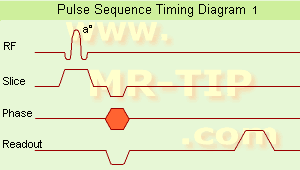 The schematic figures of a
 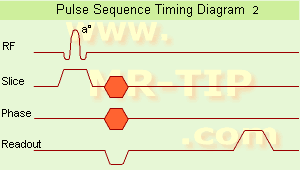 The
The  Random Page
 top
top