Magnetic Resonance - Technology Information Portal Friday, 3 September 2010••
Info
  Sheets


Out-
      side


 'Magnetization Prepared RApid Gradient Echo' 
SEARCH FOR    
 
  2 3 5 A B C D E F G H I J K L M N O P Q R S T U V W X Y Z
Result : Searchterm 'Magnetization Prepared RApid Gradient Echo' found in 1 term [] and 2 definitions []
1 - 3 (of 3)     
Result Pages : [1]
 bottom
MRI Resources  
Software - DICOM - Contrast Agents - Distributors - Bioinformatics - Fluorescence
 
Magnetization Prepared Rapid Gradient EchoInfoSheet: - Sequences - 
Intro, 
Overview, 
Types of, 
etc.
 
(MP-GRE / MPRAGE / MP-RAGE) A fast 3D gradient echo pulse sequence using a magnetization preparation pulse like TurboFLASH. Only one segment or partition of a 3D data record is obtained per inversion preparation pulse. After the acquisition, for all rows a delay time (TD) is used to prevent saturation effects.
MPRAGE is designed for rapid acquisition with T1 weighted dominance. Fast gradient echoes are characterized by their rapid sampling time, high signal intensity and image contrast while approaching steady state (the echo is collected during the time when tissues are experiencing T1 relaxation). The rapid speed of the acquisition makes it an excellent alternative to breath-hold abdominal imaging, neuro, dynamic bolus, MR angiography and cardiac imaging.
See Gradient Echo Sequence.
 
Images, Movies, Sliders:
 Brain MRI Sagittal T1 001  Open this link in a new window
    
 
spacer
Further Reading:
  Basics:
Quality Control Issues in MRIOpen this link in a new window
   by dnl.ucsf.edu    
Turbo Field EchoInfoSheet: - Sequences - 
Intro, 
Overview, 
Types of, 
etc.MRI Resource Directory:
 - Sequences -
 
(TFE) Turbo field echo is a gradient echo pulse sequence with data acquisition after an initial 180° (similar to IR) preparation pulse for contrast enhancement. The difference between a FFE and TFE other than the speed of the sequence is that the image is acquired while approaching steady state (the echoes are collected during the time in which the tissues are experiencing T1 relaxation).
The contrast is prepared one time, which means the contrast is changing while the echoes are collected and can be manipulated by selecting the type and timing of the prepulse. A delay time is given before the actual image acquistion. To achieve T1 contrast the 180° prepulse is followed by an operator selected delay time, that results in no signal from the targeted tissue. So when the echoes are acquired, no signal is present, additional RF spoiling is performed to optimize for T1 contrast. The delay chosen corresponds to when T1 relaxation reaches and suppresses T1 signal or optimizes the difference between tissues. Contrast for these sequences are enhanced when K-space is filled using a centric or low-high ordering. A TFE can be acquired with a 2D or 3D technique and with or without T1, T2 weighting.
See Ultrafast Gradient Echo Sequence, TurboFLASH and Magnetization Prepared Rapid Gradient Echo (MPRAGE).
spacer
Further Reading:
  Basics:
Sequence for Philips(.pdf)Open this link in a new window
   by www.droid.cuhk.edu.hk    
Pediatric and Adult Cochlear Implantation1Open this link in a new window
2003   by radiographics.rsnajnls.org    
MRI Resources  
MRI Technician and Technologist Jobs - Raman Spectroscopy - Mobile MRI Rental - Education - Musculoskeletal and Joint MRI - MRI Accidents
 
Ultrafast Gradient Echo SequenceInfoSheet: - Sequences - 
Intro, 
Overview, 
Types of, 
etc.MRI Resource Directory:
 - Sequences -
 
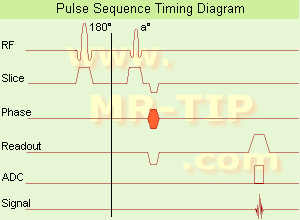
Ultrafast Gradient Echo Sequence Timing Diagram In simple ultrafast GRE imaging, TR and TE are so short, that tissues have a poor imaging signal and — more importantly — poor contrast except when contrast media enhanced (contrast enhanced angiography). Therefore, the magnetization is 'prepared' during the preparation module, most frequently by an initial 180° inversion pulse.
In the pulse sequence timing diagram, the basic ultrafast gradient echo sequence is illustrated. The 180° inversion pulse is executed one time (to the left of the vertical line), the right side represents the data collection period and is often repeated depending on the acquisition parameters.
See also Pulse Sequence Timing Diagram, there you will find a description of the components.
Ultrafast GRE sequences have a short TR,TE, a low flip angle and TR is so short that image acquisition lasts less than 1 second and typically less than 500 ms. Common TR: 3-5 msec, TE: 2 msec, and the flip angle is about 5°. Such sequences are often labeled with the prefix 'Turbo' like TurboFLASH, TurboFFE and TurboGRASS.
This allows one to center the subsequent ultrafast GRE data acquisition around the inversion time TI, where one of the tissues of interest has very little signal as its z-magnetization is passing through zero.
Unlike a standard inversion recovery (IR) sequence, all lines or a substantial segment of k-space image lines are acquired after a single inversion pulse, which can then together be considered as readout module. The readout module may use a variable flip angle approach, or the data acquisition may be divided into multiple segments (shots). The latter is useful particularly in cardiac imaging where acquiring all lines in a single segment may take too long relative to the cardiac cycle to provide adequate temporal resolution.
If multiple lines are acquired after a single pulse, the pulse sequence is a type of gradient echo echo planar imaging (EPI) pulse sequence.
See also Magnetization Prepared Rapid Gradient Echo (MPRAGE) and Turbo Field Echo (TFE).
spacer
Further Reading:
  Basics:
Fast spin echo and fast gradient echo MRI with low acoustic noise.Open this link in a new window
June 2001   by www.ncbi.nlm.nih.gov    
  News & More:
Advantages and Drawbacks of Fast MRIOpen this link in a new window
Monday, 21 April 2003   by www.medinews.com    
MRI Resources  
Databases - MR Guided Interventions - MRI Technician and Technologist Career - MRI Accidents - IR - PACS
 
     1 - 3 (of 3)     
Result Pages : [1]
 Random Page
 
MR-TIP    
Community   
User
Pass
Forgot your UserID/Password ?  


Typical instruction time after a mayor software update :
more than 3 days 
1 to 3 days 
3 to 8 hours 
1 to 3 hours 
minutes 
plug and play 
no updates 

Look
      Ups


Magnetic Resonance - Technology Information Portal
Member of SoftWays' Medical Imaging Group - MR-TIP • Radiology-TIP • US-TIP • The-Medical-Market
Copyright © 2003 - 2010 SoftWays. All rights reserved.
Terms of Use | Privacy Policy | Advertising
 [last update: 2010-08-30 03:21:01]